
Does underfloor heating add value when you sell your home?
The short answer
It can, but nobody can honestly tell you by how much. We know of no Australian study that measures what floor heating adds to a sale price, and the figures you’ll find online are either guesses or from overseas. What research does show is that buyers pay more for homes that are cheaper to keep comfortable, once they’re told. Floor heating helps a sale when it’s built well, cheap to run and backed by paperwork the buyer can read. Built badly, it’s an expensive heater the owners stopped using.
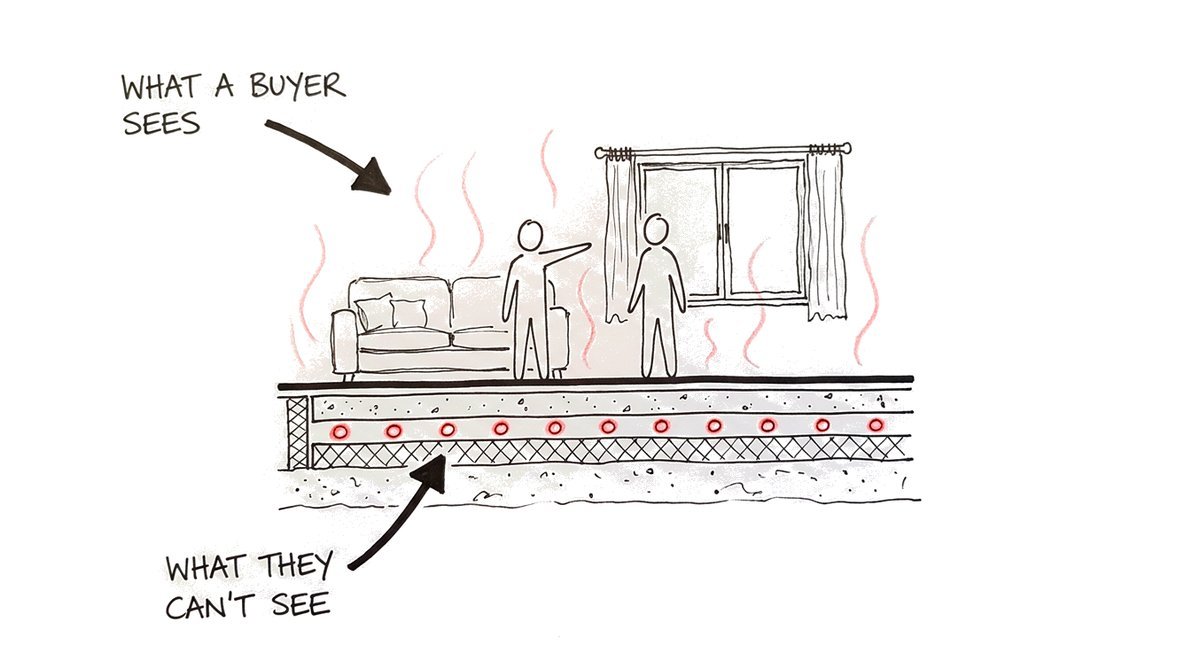
Sometimes this question comes from people who are about to sell. More often it comes from people who are building and want to know whether floor heating is money they’ll get back one day. Both deserve a straight answer, and the straight answer starts with what’s actually known, which is less than most websites suggest.
Is there any proof floor heating raises a sale price?
Not that we can find. Plenty of pages say floor heating “adds value” or “sells homes faster”, and some quote a figure, but none we’ve seen shows where the figure came from. The article that used to sit on this page said much the same, without a source, and this one replaces it. If someone gives you a number for what floor heating adds to a Perth house, ask them for the study.
The closest real evidence is about energy ratings rather than heating. Canberra has made sellers show a home’s energy rating since 1999, and a federal study of Canberra house sales in 2005 and 2006 found that each extra star went with about $11,000 more on a median house of $365,000. That tells you buyers will pay for a home that’s cheaper to keep comfortable when they can see it in writing. It doesn’t tell you what floor heating is worth, because the star rating measures the building’s shell, its insulation, glass and orientation, and not the heater inside it.
What does a buyer actually notice?
The warmth, if the inspection happens in winter. A house that’s evenly warm in every room, with no units on the walls, no grilles in the ceiling and nothing humming, feels different the moment you walk in. One family we’ve done three homes for put it better than we could: “It is always a pleasure when we have visitors in winter… and explain how it is that they have walked into a house which is uniformly beautifully warm.”
What a buyer can’t do is look under the floor. They can’t see whether there’s insulation under the pipes, whether the slab edge was broken or what the system costs to run, and neither can a building inspector. So at sale time, a heating system is worth roughly what the seller can show about it. A careful buyer may ask for last winter’s power bills, and those bills tell the story the floor can’t.
When floor heating counts against a house
When it was built cheaply. On our modelled running costs, a 200 m² floor built right runs at about $240 a winter month, and the same floor built the common cheap way, with the pipe in an uninsulated slab and no thermal break, runs at about $601. Both are modelled estimates at Synergy’s July 2026 rate, and the gap adds up to about $36,100 over twenty winters. Owners of the $601 version rarely rip the floor out. They switch it off, and then the house is selling a heating system nobody uses.
The other thing that worries buyers is the unknown: a manifold with no labels, no drawing of where the pipes run, no record of a service, and an owner who isn’t sure how the controls work. The system may be perfectly good, but the buyer has nothing to go on, and people discount what they can’t judge.
What to hand over to the next owner
If you’re building now, ask for the paperwork as part of the job and keep it with the house documents. The useful pieces are the heat-load calculation the system was designed from, the as-installed drawing of the pipe loops, the commissioning record showing each loop balanced, and the modelled running cost. Add the service history (a heat pump should be checked about every two years) and your own winter power bills, and the next owner can see in ten minutes that the floor was done properly.
If you’re selling a house that already has floor heating, gather what you can find and have the system serviced before the listing. A written service report is the closest thing a buyer will get to seeing under the slab. If the heat source is old, our article on how long hydronic heating lasts explains which parts wear out and which don’t.
Should you add floor heating just to sell?
No, and we’d say so even though it’s what we do. In a finished house, floor heating means lifting the floors and laying new ones, which we explain in putting underfloor heating into an existing home. Nothing we’ve seen suggests a buyer would pay that back. If you’re selling within a year or two, spend the money where buyers can see it.
If you’re building a home you plan to live in, decide floor heating for your own winters. Whether it’s worth it comes down to the comfort, the floor you’re laying and what it costs to run, and our article on the pros and cons in Perth goes through that properly. If it’s right for you, built well, the resale side tends to look after itself, because a warm house that’s cheap to run is easy to show off.
Other questions people ask us
Does floor heating improve my home’s energy rating?
Not the star rating on your plans, which measures the building’s shell rather than the heating. The newer whole-of-home part of the building code does look at the appliances a house uses, and how a heat-pump floor heating system is counted there is a good question for your energy assessor. Our article on whether a 7-star home still needs heating covers the rest.
Will a buyer’s inspector check the floor heating?
An inspection can confirm the system turns on and the floor gets warm, and that’s about all. Nobody can see the pipes or the insulation once the floor is laid, which is why the drawings and the service record carry so much weight.
Does radiator heating help sell an older home?
The same rules apply: a quiet system that warms every room and comes with its paperwork is a pleasant surprise in a cold old house. As with floor heating, we wouldn’t put it in only for the sale.
Where to go from here
If you’re building or renovating in Perth or the south-west, the 5-minute quote gives you your options in writing within 3 working days, each with its price and a modelled running cost, and you don’t need final plans to start. That running cost is worth keeping with the house documents. If you just want the numbers for now, the Running Cost Calculator shows the built-right and built-cheap figures for your floor area.