
Is underfloor heating worth it in Perth? The pros and the cons
The short answer
For a new Perth home with tiled or polished concrete floors, usually yes, as long as it’s designed and built properly. Perth’s winters are short, but the mornings are cold and our hard floors are what make a house feel cold. Built right, floor heating in a 200 m² home runs at about $240 a winter month; built cheaply, the same floor costs about $601 (both modelled estimates). It’s rarely worth it in a small, very well-insulated home where one reverse-cycle unit already keeps you comfortable, or in an existing home where the floors would have to come up.
We hear this question a lot, often asked with a slightly guilty look, as if wanting warm floors in Perth were a bit indulgent. It’s a fair question. We’re not Melbourne or Canberra, and for half the year nobody thinks about heating at all. The honest answer depends less on the weather than on the house you’re building.
Perth’s winter is mild, so why does the house feel so cold?
Because Perth’s cold is a morning cold. The Bureau of Meteorology’s Perth station averages 8.1 degrees overnight in July and 18.5 in the afternoon, and on 25 July 2025 Mt Lawley got down to 0.3 degrees, the coldest Perth morning in 15 years. By lunchtime the day is pleasant, which is why we tell ourselves winter isn’t really a thing here. The cold bit is 6 to 9 in the morning, when you’re barefoot in the kitchen.
Then there’s the way we build. Perth houses are designed for summer: tiles or polished concrete on a slab, open-plan living, high ceilings, lots of glass. All of that is lovely in February. In July the slab under those tiles sits cold, and a hard floor draws heat out of your feet far faster than carpet would. You can have the air at 21 degrees and still feel cold, because the floor is what you’re touching. And most homes don’t get to 21: a study of 100 homes across southern Australia, including WA, found four in five sat below 18 degrees on average through winter.
What floor heating does that air conditioning can’t
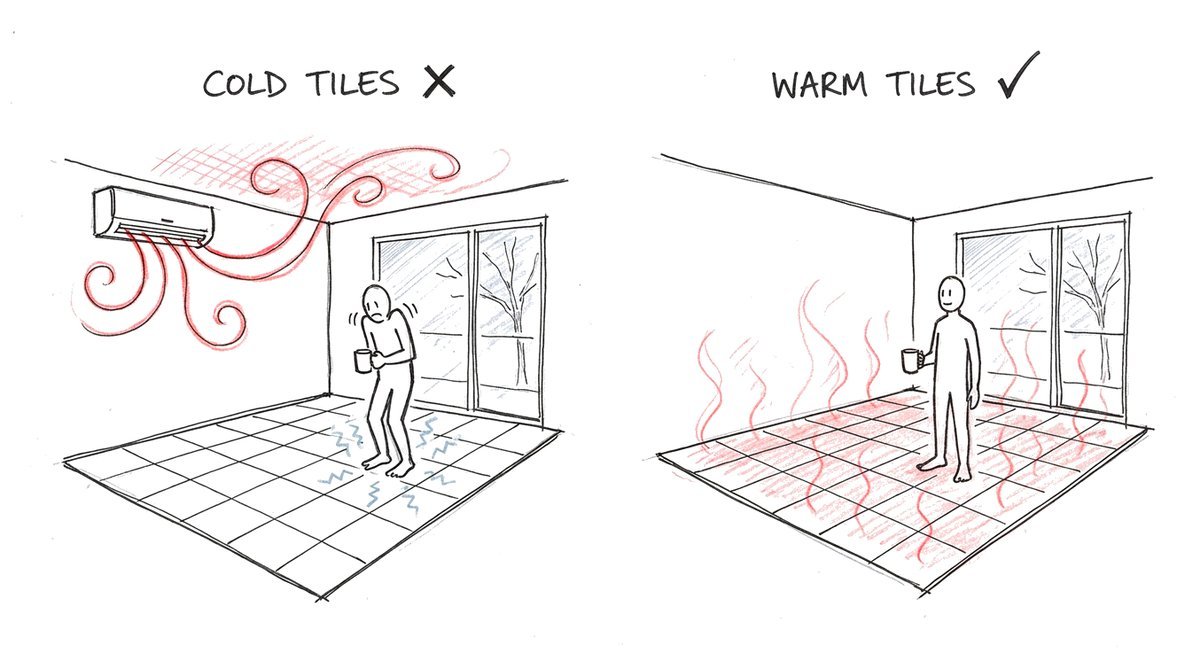
A reverse-cycle system heats the air. Warm air rises, so it gathers under the ceiling, and the air down where you’re sitting is the coolest in the room. Most of us turn the thermostat up to compensate, which is where the bill comes from.
Floor heating works the other way round. The whole floor becomes a gentle, low-temperature heater, and most of its warmth reaches you by radiation, the same way winter sun feels warm on your face when the air is cold. Phil explains it with the body: between 50% and 60% of the heat you trade with a room goes by radiation, so that’s the kind of warmth you notice. It’s also why a floor heated by water at around 40 degrees feels better than a gas heater running at 90 or 100 in the corner.
You’ll read online that floor heating is 30% more efficient than other heating. Phil’s view, from years of Australian houses, is that it’s more like 15% the way we build here, and only when it’s done right. That’s still a real saving, and we’d rather you heard the smaller, true number from us.
What it costs to run in Perth
These are our modelled running costs for a winter month, on an air-source heat pump at Synergy’s July 2026 home rate (33.26 cents a kilowatt-hour). The difference between the two columns is the engineering: insulation under the pipes and around the slab edge, the right floor build-up, and a heat pump sized and placed properly.
| Heated area | Built right | Built cheap |
|---|---|---|
| 150 m² | about $181 a month | about $451 a month |
| 200 m² | about $240 a month | about $601 a month |
| 250 m² | about $301 a month | about $752 a month |
| 300 m² | about $361 a month | about $902 a month |
All modelled estimates, not promises: your house, your thermostat and next year’s tariff will move them. Over twenty winters, the gap on a 200 m² home comes to about $36,100. Designed right, floor heating runs in the same league as a good reverse-cycle system, without the blown air. Our Running Cost Calculator works it out for your own floor area.
The downsides, and when it isn’t worth it
Floor heating costs more to put in than a reverse-cycle system, and it has to be decided early, before the slab is poured. It’s gentle rather than fast: it won’t blast a cold room warm in five minutes the way a fan heater does, so it works best left to run on a timer through the cold months. And if it’s built badly, there’s no fixing it later short of digging up the floor.
Sometimes the right answer is no. If you’re building a compact, very well-insulated home with carpet in the bedrooms, a single well-placed reverse-cycle unit may keep you perfectly comfortable for much less money. If you only want a warm bathroom floor, an electric mat under the tiles is the simple answer, and Phil says so himself. And if the house is already built, putting floor heating in means lifting the floors, so radiators are usually the better way to the same kind of warmth (we explain why in putting underfloor heating into an existing home).
It also isn’t worth it done cheaply. A cheaply built floor costs about two and a half times as much to run (the $240 against $601 above) and still doesn’t feel warm on a July morning. That’s the version people regret.
The catch: it’s decided before the slab is poured
Almost everything that decides your running cost goes in before the concrete: the insulation under the pipes, the insulation around the edge of the slab, the pipe layout room by room. Once the slab is down, none of it can be added. That’s why floor heating has to be part of the design conversation with your builder early, not an upgrade chosen at the colour selection.
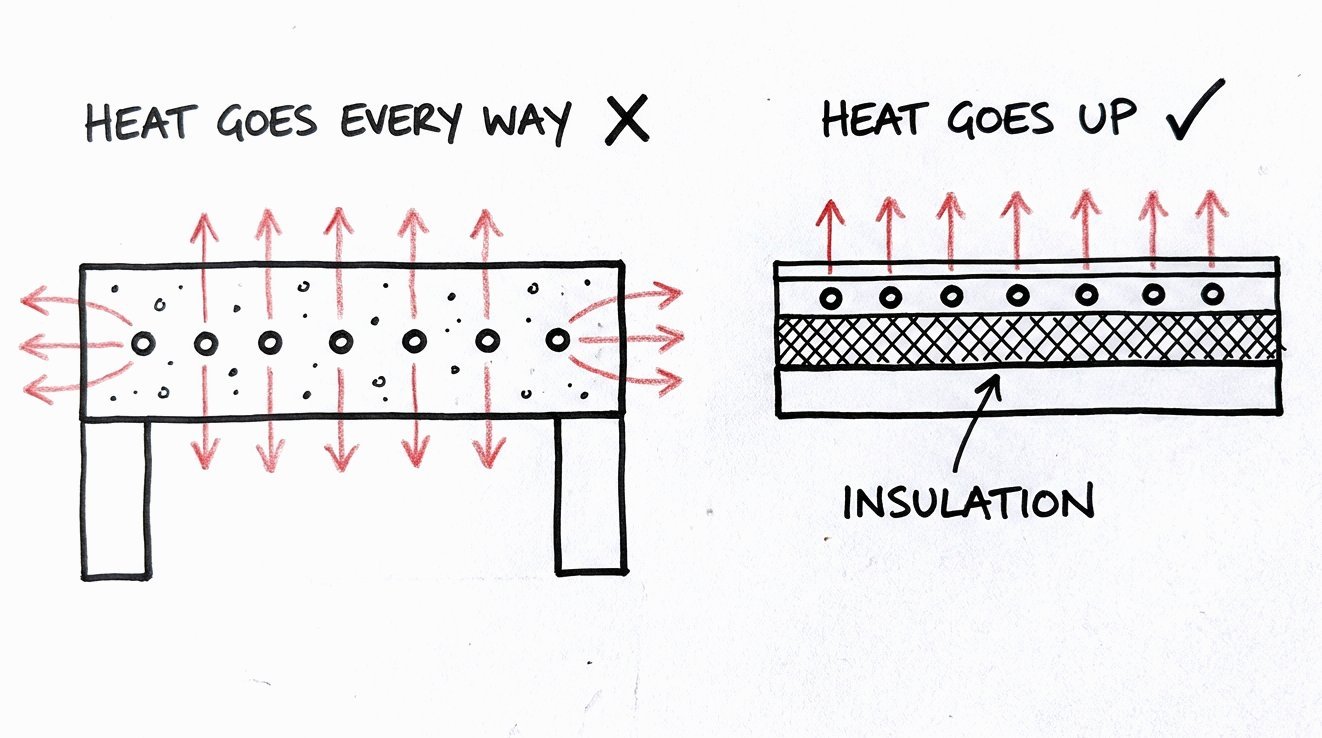
The way the floor is built also decides how quickly it responds, which matters with Perth’s big swing between morning and afternoon. A thin heated screed on insulation starts to warm the room in 15 to 30 minutes. A heated slab on the ground takes about 45. A heated first-floor suspended slab, which we advise against, can take hours or even days, and keeps pumping out heat on the 26 degree afternoon that follows a cold morning.
Other questions people ask us
Is underfloor heating energy efficient?
It can be, when it’s designed and built properly. A heat pump turns each unit of electricity into about three units of heat, the floor runs on water at around 40 degrees, and insulation underneath sends the warmth up into the room. Built cheaply, much of that heat goes into the ground instead, which is the difference between $240 and $601 a month in the table above.
Can I leave some rooms out to save money?
You can, but think hard about it. Phil’s experience is that people who leave out the laundry or a hallway to save a few metres of pipe almost always tell us years later that they wish they hadn’t, because it’s the one cold room in the house. A spare room’s loop can simply be turned off at the manifold, like a tap, so heating it costs nothing until you need it.
Do I need a thermostat in every room?
No, and we usually advise against it. A well-designed floor runs quietly in the background, and people with a thermostat in every room end up setting them all the same. One zone per level, or two for a large single-storey home, is simpler and cheaper.
Will it crack my polished concrete or tiles?
Floor heating doesn’t have to crack anything. Cracks in heated floors come from a floor that has nowhere to move as it warms and cools, which is why expansion joints go in the right places at the design stage, before the pour.
Can I run it on my solar panels?
Partly, and Perth is a good place to try. A heat pump can put warmth into the floor in the middle of the day while the panels are producing, and the floor gives some of it back into the evening. Synergy’s Midday Saver plan also makes power between 9am and 3pm much cheaper than in the evening peak, which suits a floor that stores heat. Solar lowers the bill, but it can’t make up for a floor that leaks heat.
Where to go from here
If you’re building in Perth or the south-west, the 5-minute quote gives you your options in writing within 3 working days, each with its price and a modelled running cost, and you don’t need final plans to start. If you’re not there yet, the Running Cost Calculator shows the built-right and built-cheap numbers for your floor area, and the Slab Pour Deadline Checker tells you how long you have before the decision makes itself.