
Hydronic floor heating or ducted reverse-cycle: which is better in Perth?
The short answer
Both are heat pumps, so on running cost they’re closer than most people think. Ducted reverse-cycle costs much less to put in, warms a room within minutes and cools the house in summer, which floor heating can only partly do. Built right, hydronic floor heating runs in the same league, about $240 a winter month for a 200 m² Perth home (a modelled estimate, against about $601 built cheaply), and it warms you from the floor up with no blown air. In a new home with hard floors and high ceilings, floor heating for winter and air conditioning for summer is often the best of both.
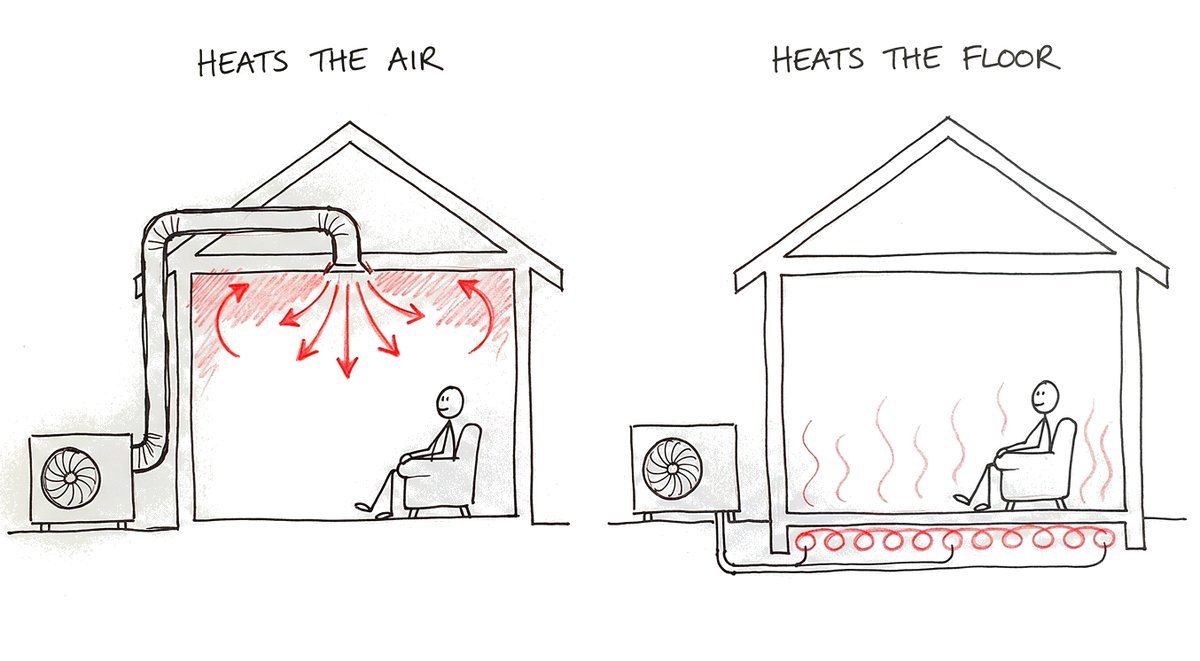
If you’re building in Perth, ducted reverse cycle is the default. Your builder offers it, the display homes have it, and CHOICE says “air con is by far the cheapest way to heat your home”. So it’s fair to ask why anyone would pay more for floor heating. The honest answer depends on the house you’re building and on what you want a winter morning to feel like.
Aren’t they both heat pumps?
They are, and that’s the first thing to understand. Each system has a heat pump outside that collects heat from the outside air and carries it into the house. Ducted reverse cycle puts that heat into air, which a fan blows through ducts in the roof space and out of vents in the ceiling. Hydronic floor heating puts it into water, which a pump sends through loops of pipe in the floor. It’s the same kind of machine with a different way of delivering the warmth, and almost every difference between the two comes from that.
So we’ll say plainly what the consumer press says: per unit of heat, a good reverse-cycle system is hard to beat. An engineer writing in Renew magazine compared the two in his own Melbourne home, renovated to Passive House principles, and found his reverse-cycle unit about 30% more efficient at getting heat into the house than his heat-pump hydronic system. We don’t argue with that. In a house that airtight and that well insulated there’s very little heat to replace, and the cheaper machine makes sense.
Which costs less to run in Perth?
Here the quality of the build matters more than the choice of system. Our modelled running cost for a 200 m² Perth home with floor heating built right is about $240 a winter month on an air-source heat pump, at Synergy’s July 2026 home rate of 33.26 cents a kilowatt-hour. Built the cheap way, with the pipe in an uninsulated slab and no thermal break, the same floor costs about $601, and over twenty winters that gap comes to about $36,100. Both are modelled estimates, not promises.
Our answer to the reverse-cycle question follows from that. Badly designed and installed, floor heating costs many times more to run than reverse-cycle heating. Designed and installed properly, hydronic runs in the same league as a good reverse-cycle system, without the blown air, and it can come in a little under. You’ll read online that hydronic is 30% more efficient. Phil’s view, from years of Australian houses, is that the comfort advantage is more like 15%, and only when the floor is built right.
The reason it can come out level, or ahead, is the temperature you need. With air heating the warm air rises and the walls and floor stay cold, so people turn the thermostat up. Phil calls it the strange thing about air conditioning: “it says 25 or even 28° on the room temperature controller, but you’re still cold.” In a Fremantle house he filmed, heated with radiators, the owner sets 19 degrees and it’s perfectly warm. Heating to a lower air temperature is where the running cost evens out.
How does each one feel on a July morning?
This is where the two really part ways. Ducted heating blows warm air from the ceiling, and warm air rises, so it pools under the ceiling while the air around your ankles stays cool. In WA the return air is usually drawn back from up high as well, so the warmest air at the top of the room gets pulled straight back out and round again, which Phil describes as the system short-circuiting. High and raked ceilings, common in new Perth homes, make it worse, because more of the room is above your head.
A heated floor works from the other end. Between 50% and 60% of the heat your body trades with a room goes by radiation, the warmth you feel stepping out of the shade into winter sun, and a warm floor gives you mostly that. The warmth starts at your feet and stays low in the room, and the walls and furniture warm up and give heat back too. There’s no fan in the room, so it’s silent, with no draught across your face and no dust kept moving around. Our article on the pros and cons of floor heating in Perth goes further.
The trade-off is speed. A ducted system takes the chill off a room within minutes. A floor in an insulated screed starts to warm the room in 15 to 30 minutes and a heated slab on the ground takes about 45, so floor heating is run on a timer through the cold months rather than switched on when you feel cold.
 6 min
6 min
| Ducted reverse cycle | Hydronic floor heating | |
|---|---|---|
| Cost to put in | Lower | Higher, and decided before the slab is poured |
| Running cost | Efficient | Same league built right; far more built badly |
| How the warmth reaches you | Warm air from ceiling vents | Radiant warmth from the floor up |
| Speed | Within minutes | 15 to 45 minutes; best on a timer |
| Summer cooling | Full cooling | About a quarter of a Perth home’s need |
| In the room | Fan noise and moving air | Silent, nothing on the walls or ceiling |
| In an existing home | Often possible | Only by lifting floors; radiators instead |
When is ducted reverse cycle the better buy?
More often than you might expect from a floor heating company, and we’d rather you heard it from us. If you’re building a compact, well-insulated home, especially with carpet in the bedrooms, ducted reverse cycle may keep you comfortable for much less money up front. If you need cooling anyway and the budget stretches to one system, reverse cycle is the one that does both, because a floor can provide only about a quarter of the cooling a typical Perth house needs. Phil says as much himself: “air conditioning is fantastic. Like you need it for cooling.”
And if the house is already built, putting floor heating in means lifting the floors, so radiators are usually the better way to hydronic warmth (see putting underfloor heating into an existing home).
When is hydronic floor heating worth it?
It earns its place in a new home with tiled or polished concrete floors, open-plan living and high ceilings, where blown air struggles and hard floors make a house feel cold on a July morning that averages 8 degrees at the Bureau’s Perth station. It suits people who are home in the mornings and evenings and want the house quietly warm without hearing it.
It also suits anyone who wants to use cheap midday power: a heat pump can warm the floor while Synergy’s Midday Saver rate applies, between 9am and 3pm, and the floor gives some of that warmth back into the evening (more in running floor heating on cheap midday power).
It has to be decided early, though. The insulation under the pipes and around the slab edge, which makes most of the running-cost difference above, goes in before the concrete and can’t be added later.
Can I have floor heating and reverse cycle?
Yes, and in many new Perth homes that’s the sensible answer. Floor heating does the winter, with quiet, even warmth from May to September, and a reverse-cycle system, ducted or split, does the summer. Some houses run both from one heat pump, which saves space and electrical supply, but for a typical home two separate systems are still cheaper to install. Our article on combining floor heating with air conditioning covers how the two work together.
Other questions people ask us
Is hydronic heating expensive to run?
Not when it’s built right. Our modelled estimate for a well-built 200 m² floor on a heat pump in Perth is about $240 a winter month, against about $601 for the same floor built cheaply. The difference is the insulation and the design rather than the pipe.
Is ducted heating cheaper to install than floor heating?
Yes, usually by a good margin, and it cools as well. Floor heating costs more because it’s built into the floor, with a heat pump, pipework, a manifold and insulation under it. Your quote shows the price of each option for your house.
Can I add floor heating to a house that already has ducted heating?
Only by lifting the floors, so it usually makes sense only in a major renovation. Radiators on a heat pump give the same kind of warmth with nothing dug up, and the ducted system can stay for summer.
Where to go from here
If you’re building in Perth or the south-west, the 5-minute quote gives you your options in writing within 3 working days, each with its price and a modelled running cost, so you can weigh floor heating against what your builder has offered with real numbers, and you don’t need final plans to start. If you’d like the running cost for your own floor area first, use the Running Cost Calculator, and for the bigger picture, see what hydronic heating is and how it works.