
What is hydronic heating, and how does it work?
The short answer
Hydronic heating warms your home with water. A heat source outside, usually an electric heat pump and sometimes a gas boiler, heats water to between about 25 and 55 degrees. A small pump sends it through sealed loops of pipe in the floor or to radiators on the walls, which pass the warmth to the room, and the water comes back to be warmed again. Built right, floor heating in a 200 m² Perth home costs about $240 a winter month to run on a heat pump (a modelled estimate), in the same league as a good reverse-cycle system.
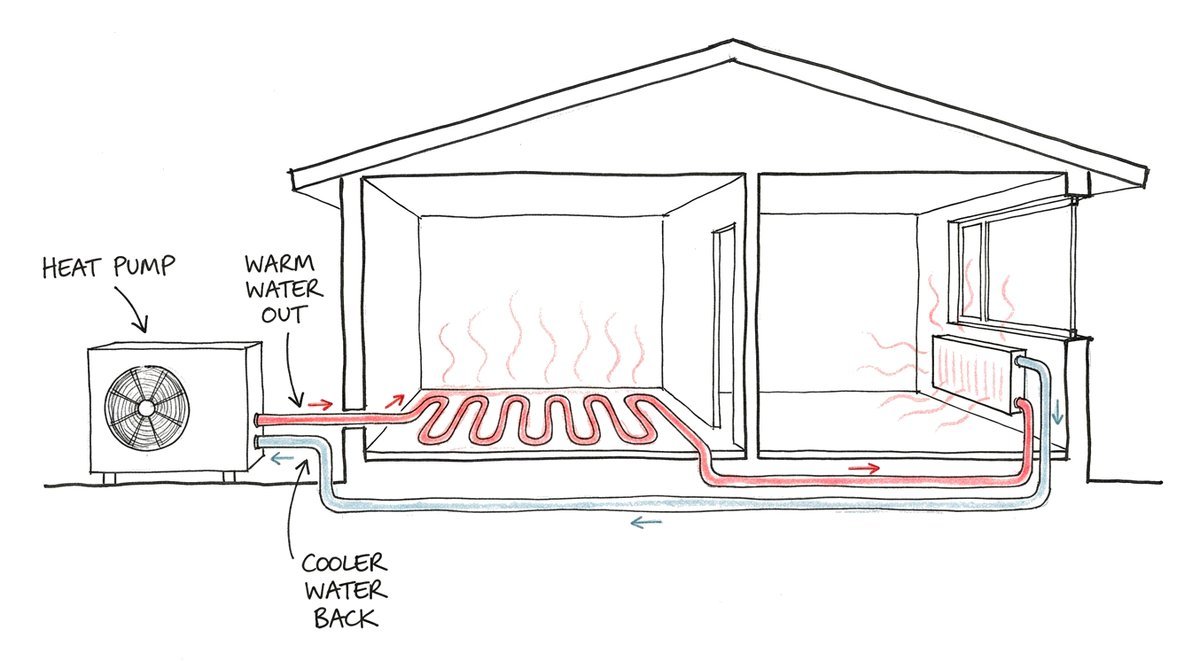
Hydronic is one of those words that makes a simple thing sound technical. You might have heard it from a friend in Melbourne with a radiator under every window, or from a builder offering floor heating as an upgrade. It’s all the same idea, and it takes a few minutes to understand.
What does hydronic actually mean?
Hydronic just means using water to carry heat. Instead of heating air and blowing it into a room, a hydronic system heats water, pipes it to where the warmth is wanted, and lets a floor or a radiator pass that warmth to the room. It’s a car’s cooling system run the other way round. In a car, water carries heat away from the engine to the radiator at the front; in a house, water carries heat from the heat pump to the rooms.
Water is used because it carries a lot of heat in a small space. A pipe about as thick as a garden hose can carry the warmth for a whole room, where moving the same heat with air takes a duct many times wider and a fan to push it. Most of Europe has heated its homes this way for about a hundred years.
How does a hydronic heating system work?
Follow the water round once and the whole system makes sense. It starts at the heat source. In most new systems that’s an air-to-water heat pump, a box outside the house much like the outdoor unit of an air conditioner, which collects heat from the outside air and puts it into water. It can also be a gas boiler, or a heat pump that draws its heat from the ground.
A small circulating pump pushes the warm water along insulated pipes to the manifold, the box where every pipe loop in the house starts and ends. From there the water runs out through the loops, the heat moves out of the water into the floor or the radiator and then into the room, and the water comes back to the manifold a few degrees cooler. It returns to the heat pump to be warmed again. It’s the same water the whole time, sealed in and going round and round.
A few smaller parts keep it healthy, and our article on what’s inside a hydronic system goes through them. Thermostats on the walls tell the system when to run. An expansion vessel takes up the water’s growth as it warms. Automatic air vents let out the bubbles that work free in the first year or two, because pockets of air are, in Phil’s words, “the enemy of hydronic systems”: they stop the water getting through. And a good controller lowers the water temperature on mild days and raises it on cold ones, so the heat pump never works harder than it has to.
What is a hydronic loop?
A loop is one continuous length of pipe that leaves the manifold, snakes back and forth under a room, and comes back to the manifold. A house has many of them, for a good reason. The longer a pipe, the bigger the pump needed to push water through it, and by the far end the water would have given away most of its heat, leaving that end of the floor cold. So Phil keeps each loop to 100 metres at most, and a big open living, dining and kitchen area might have four loops of its own.
Shorter loops let the water be set precisely. In one of Phil’s videos the plan is water going out at 37 degrees and coming back at 30, which keeps the whole floor at an even temperature with no cold patches. And because each loop can be closed at the manifold on its own, a room nobody’s using can be turned off like a tap.
 3 min
3 min
Floor heating, radiators, or both
Floor heating puts the loops in the floor. In a new home the pipe goes into the concrete slab or, better, into a screed: a layer of concrete-like topping poured over insulation, so the heat goes up into the room instead of down into the ground. The whole floor becomes one large, gentle radiator running on water at about 25 to 40 degrees, and it has to be planned before the slab is poured. We compare the ways of doing it in in-slab, screed or electric.
Radiators bring the same warm water to slim panels on the walls. They run warmer, on water at around 45 to 55 degrees, and they’re the natural way into a house that’s already built, because nothing gets dug up and installing takes about a day per radiator. Our article on radiators or floor heating goes through which suits which home.
You can also have both on one system. Phil filmed an 1895 house in Fremantle with its original jarrah floorboards: radiators in the old rooms, floor heating in the new extension and the bathroom, and a heated towel rail, all running from one heat pump. The pipes can carry cool water in summer too, but only about a quarter of the cooling a Perth house needs, so floor cooling works alongside air conditioning rather than replacing it.
What heats the water: a heat pump or a gas boiler?
Most hydronic systems we install now run on an air-to-water heat pump. Think of it as a lift that carries heat into your house: it uses a little electricity to collect heat that’s already in the outside air and lift it to a useful temperature, delivering three to four units of heat for each unit of electricity. The lift has less work to do the lower the water temperature, which is why heat pumps and floor heating suit each other. As Phil puts it, “it’s much easier for the heat pump to produce 30 or 35° water than it is 50 or 55° water.”
We install gas boilers as well. On running cost a heat pump usually comes out ahead in Perth, so it’s what we suggest first, but if you’d rather heat with gas we’ll design and install a gas boiler (our article on gas boiler or heat pump weighs the two). Geothermal is a heat pump that takes its heat from the ground instead of the air, cheaper to run and much dearer to put in, as what geothermal costs explains.
What it costs to run, and how it compares with reverse cycle
These are our modelled running costs for hydronic floor heating through a Perth winter month, on an air-source heat pump at Synergy’s July 2026 home rate of 33.26 cents a kilowatt-hour.
| Heated area | Built right | Built cheap |
|---|---|---|
| 150 m² | about $181 a month | about $451 a month |
| 200 m² | about $240 a month | about $601 a month |
| 250 m² | about $301 a month | about $752 a month |
| 300 m² | about $361 a month | about $902 a month |
All modelled estimates, not promises. The gap between the columns is the engineering: insulation under the pipes and around the slab edge, without which up to 70% of the heat you pay for can go into the ground, and a heat pump that’s sized properly with room to breathe. Over twenty winters the gap on a 200 m² home is about $36,100. The Running Cost Calculator works it out for your floor area.
Reverse-cycle air conditioning is the fair comparison, because it’s a heat pump too. Per unit of heat it’s hard to beat, it costs much less to put in, and it cools properly in summer. What hydronic offers is the way the heat reaches you. Between 50% and 60% of the heat your body trades with a room goes by radiation, the warmth you feel stepping out of the shade into winter sun, and a heated floor gives you mostly that kind, while warm air rises to the ceiling.
Designed right, hydronic runs in the same league as a good reverse-cycle system, without the blown air. Built badly, it costs far more. We set the two side by side in hydronic floor heating or ducted reverse-cycle.
Other questions people ask us about hydronic heating
Does hydronic heating need a gas boiler?
No. Older hydronic systems in Australia mostly ran on gas, which is where the idea comes from, but most of the systems we install now run on an electric heat pump. We install both, so you can ask for either.
Can hydronic heating run on solar power?
Partly. A heat pump can warm the floor in the middle of the day while your panels are producing, and the floor gives some of that warmth back into the evening. Solar lowers the bill, but the heat is needed most on winter mornings and evenings, so it can’t carry the whole load. More in whether rooftop solar can power floor heating.
Is hydronic heating expensive to put in?
It costs more than reverse cycle, and the price depends on the floor area, the heat source, whether the pipe goes into the slab or an insulated screed, and the controls. Those vary too much between houses for an honest figure on a web page. Our article on what floor heating costs to install explains what drives the price, and the 5-minute quote gives you real prices for your house.
How long does a hydronic system last?
The pipe in the floor is rated for 50 years under its standard’s test conditions, and at floor-heating temperatures it will outlast most houses. The heat pump is the part that wears, so it gets serviced and eventually replaced without touching the floor. More in how long hydronic heating lasts.
Where to go from here
If you’re building or renovating in Perth or the south-west, the 5-minute quote gives you your options in writing within 3 working days, each with its price and a modelled running cost, and you don’t need plans to start. If you’d like the short version with pictures first, floor heating, explained covers it in a few minutes, and the heat pumps page explains how we size and site the machine that does the work.