
Is a radiator a heat exchanger? The difference in plain words
The short answer
Yes. Anything that moves heat from one thing to another without the two mixing is a heat exchanger, and a radiator moves heat from the hot water inside it to the room around it. When people in heating say “a heat exchanger”, though, they usually mean a compact unit that passes heat from one loop of water to another, say from the heating system into a swimming pool or a hot-water tank, without the two waters ever touching. So every radiator is a heat exchanger, but most heat exchangers aren’t radiators.
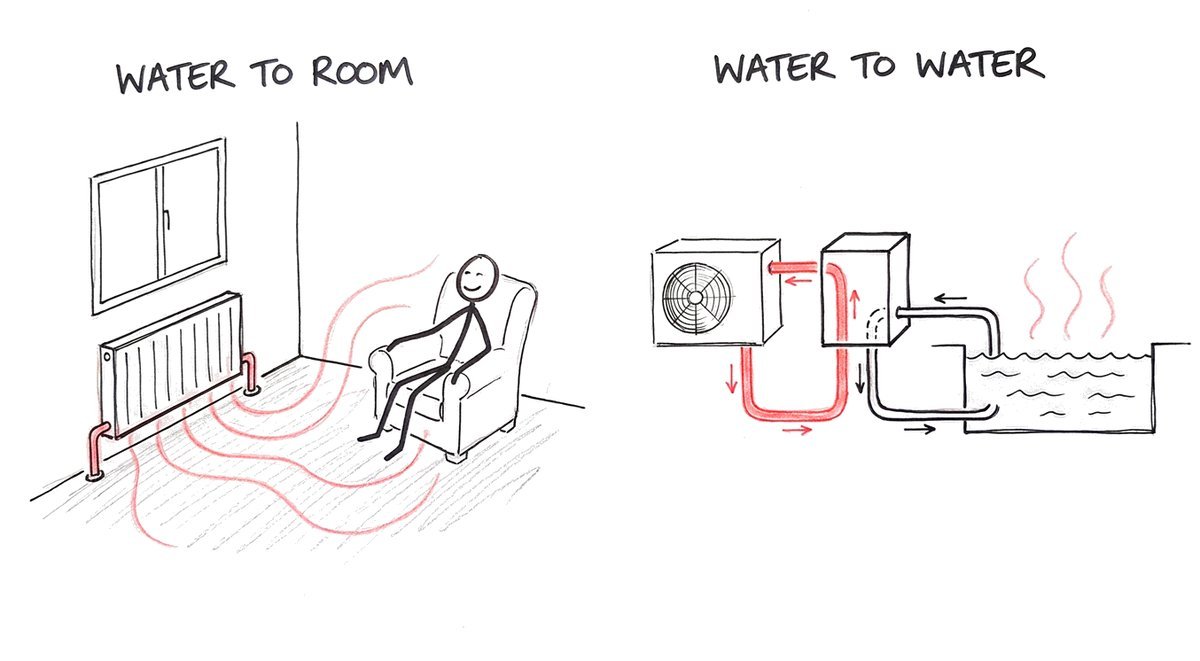
Readers come to this question from all over the world, often after finding both words on a heating diagram or a quote. The two words describe the same bit of physics doing two different jobs. Here’s what each one does, where you’ll find them in a home heating system, and why it matters.
What does a radiator actually do?
Warm water flows in at the top, gives its heat to the metal panel, and leaves cooler at the bottom to go back and be warmed again. It’s the same water going round and round. The panel then warms the room in two ways. Part of the heat travels straight out as radiation, the warmth you feel on your face from winter sun even when the air is cold, and part warms the air touching the panel, which rises gently and drifts across the room. Phil’s rule of thumb is a little over half by radiation and the rest by that slow natural movement of air.
Nothing in it moves. As Phil put it, standing next to one in an old Fremantle house, “the radiator doesn’t have any moving parts. It’s totally still”, which is why a room heated by radiators is silent and the dust stays put. A heated floor works the same way on a much bigger scale: the whole floor becomes one large, gentle, low-temperature radiator.
The radiator in your car is a heat exchanger too, just with the opposite job. It takes heat out of the engine’s water and throws it away into the air rushing through it. The radiator under your window keeps the heat in the house.
What is a heat exchanger, then?
In a heating system, the thing on the drawing labelled “heat exchanger” is usually a compact block of thin metal plates, or a coil of pipe inside a tank. One water flows along one side of the metal, a second water flows along the other, and the heat passes through the metal from the warmer to the cooler. The two waters never meet. It’s simple, well-proven technology that has been around for many decades.
Keeping the waters apart is the whole point. The water in a heating system is sealed, treated and kept free of air, because many of the parts it runs through, like the pumps and the radiators, are mild steel inside, and treated water lets them last 30 years or more. Pool water is full of chlorine or salt. Tap water has to meet drinking-water rules that heating parts aren’t made for. A heat exchanger lets heat move between them while each keeps its own water.
Where are the heat exchangers in a home heating system?
More places than you’d guess. A heat pump is built around two of them. Outside, the fan pushes air across a coil, and the refrigerant inside picks up heat even from cold air. Inside the unit, a second exchanger hands that heat over to the water that goes to your floor or radiators. Further along, there may be a plate exchanger that sends spare heat into the pool in summer, and a coil inside the hot-water tank that heats your shower water without the two waters touching.
In Perth there’s sometimes one more. A home that draws its heat from groundwater pumps bore water up through a heat exchanger and sends it back down, so the bore water never enters the house’s system. The quality of that water matters: on one Perth rescue job Phil filmed, iron bacteria in the groundwater had filled the pipes and the heat exchanger with orange-brown sludge.
Each of those handovers needs the hot side a little warmer than the cold side, and the smaller the surface, the bigger that difference has to be. That’s why radiators, being much smaller than a floor, need water at around 45 to 55 degrees while a heated floor gets by on 30 to 35, as we explain in what temperature floor heating should run at. Phil’s point is that the whole system is only as good as its weakest link, and every one of these exchangers is a link.
 9 min
Other questions people ask us
Is a heat exchanger more efficient than a radiator?
They do different jobs, so one can’t replace the other. Neither makes any heat. Both only pass it along, and how much the whole system costs to run depends on how the heat source, the pipes and the radiators or floor are designed to work together.
Does a radiator system need a separate heat exchanger?
Usually not. The same treated water runs from the heat pump through the radiators and back. A separate heat exchanger comes in when a second water joins the system, like a pool, a hot-water tank or bore water. More on radiators with a heat pump in can radiators run on a heat pump.
Can my hot water system run my radiators?
In theory, but not well. A hot water system is built to store water at 60 degrees or more, a heating system needs its own pumps, valves and expansion vessel, and tap water and heating water have to be kept apart. Done the other way round it works: a heat pump that heats the house can also heat a tank of tap water through a coil.
Where to go from here
If you’re in Perth or the south-west and thinking about radiators or floor heating, the 5-minute quote gives you your options in writing within 3 working days, each with its price and a modelled running cost, and you don’t need plans to start. For the bigger picture, floor heating, explained shows how the parts fit together, and heating an existing home covers radiators in a house that’s already built.