
What types of geothermal system are there?
The short answer
A home geothermal system is a heat pump connected to the ground, and the types differ in how that connection is made. A closed loop circulates water through buried pipe, either laid flat in trenches about one and a half metres deep or run straight down in bores that can go 60 to 120 metres. An open loop pumps groundwater up one bore and returns it down another, which Perth can do because it sits on an aquifer at around 20 degrees. On a suburban Perth block it’s usually bores or groundwater, while trenches suit rural land with room to dig.
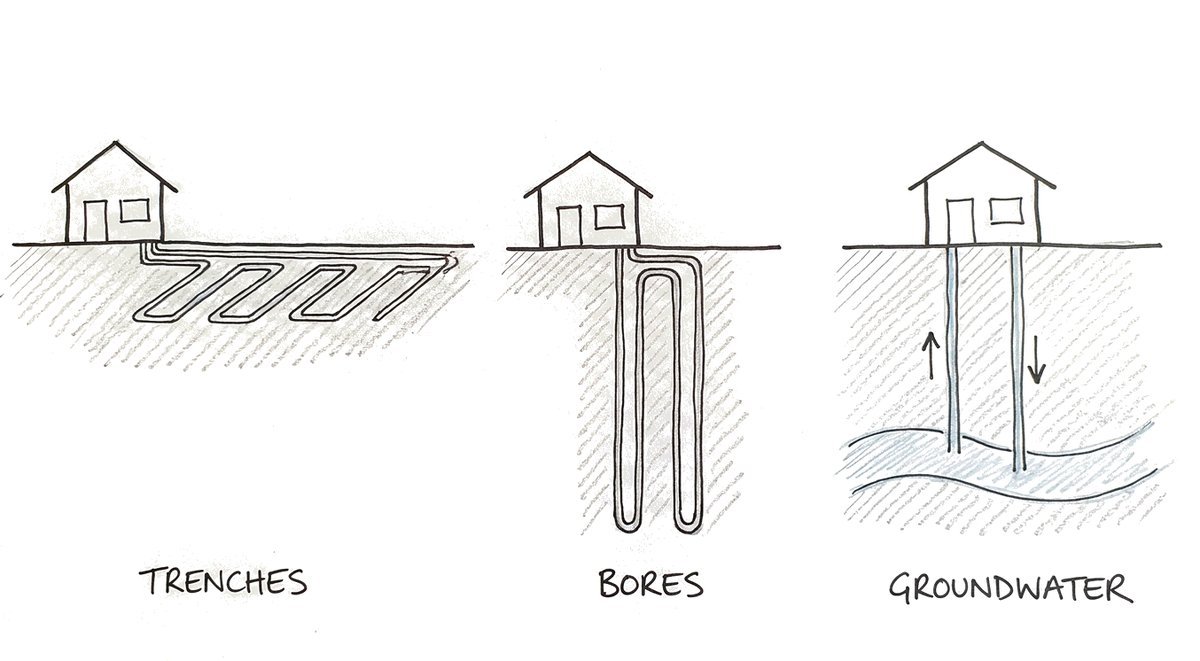
Search for geothermal and you’ll find lists of types with names that overlap and contradict each other: active and passive, direct and indirect, open and closed, horizontal and vertical. Most of it comes from cold countries and some of it is plain wrong. Underneath the names there are really only a few ways of doing it, and the choice between them is made by your block of land more than by anything in a brochure.
Is home geothermal the same as hot rocks?
No, though it’s a mix-up Phil hears a lot. Iceland heats homes with volcanic heat close to the surface. In Australia that kind of heat is kilometres down, so it isn’t something you can tap for a house. Home geothermal uses something much more ordinary: a few metres below the surface, the ground stops feeling the seasons and sits at a steady temperature all year, around 15 to 20 degrees in Perth.
That steady temperature can’t warm a house on its own. A heated floor needs water at about 30 to 35 degrees, so a heat pump does the lifting, taking warmth out of the ground loop and handing it on at a useful temperature. That’s why the old split into active and passive geothermal doesn’t really help anyone. Every geothermal heating system for a home has a heat pump and a circulating pump in it. The passive part of keeping a house comfortable belongs to its design, the shading, insulation and orientation, and it’s worth getting right whatever heats the place.
Trenches and bores: the closed loop
A closed loop is a long run of plastic pipe buried in the ground and filled with water, usually with a little antifreeze mixed in, because the heat pump chills that water well below the ground’s temperature on its way through. The water goes round and round, picking up warmth from the soil, and never touches the ground itself.
Laid flat, the pipe goes into trenches at least a metre and a half deep, below the reach of summer heat and winter cold. That takes a lot of land. On some of our south-west jobs the loop has filled half a paddock, which is fine on a farm and impossible on a 500 square metre block. Where there isn’t room, the pipe goes straight down instead. Each bore typically runs somewhere between 60 and 120 metres deep, and a house needs several, because each one can only give up so much heat.
How many bores is the question that decides whether the system works. Phil’s view, from rebuilding other people’s systems, is that the most common geothermal mistake is a ground connection that’s too small, often because one bore was left off the quote to bring the price down. The system still runs, but the heat pump struggles, and much of the time you’d have done as well with an ordinary air-source unit.
Groundwater: Perth’s open loop
Perth has an option most of the country doesn’t. The city sits on an aquifer that stays at around 20 degrees all year, which makes it a superb heat source in winter and an easy place to dump heat in summer. An open loop pumps that water up one bore, passes it through a heat exchanger and sends it back down a second bore. The groundwater and the water in your heating system never mix: they run through separate plates in the exchanger, side by side, swapping only heat.
It comes with conditions. You need a groundwater licence and a return bore, and the water has to suit the job, which isn’t a given: its quality changes from suburb to suburb. Our article on heating and cooling with bore water goes through the licence and the choice of loop in detail.
On one Dalkeith job the water comes up so clear that the only maintenance is flushing a little sand out of a filter once a year. On a City Beach job we were called in to fix, iron-oxide bacteria in the water turned to brown sludge whenever it met air and clogged the pipes and the heat exchanger. Phil’s view was that a closed loop would have cost a bit more there and saved years of maintenance.
 4 min
Refrigerant straight into the ground
There’s a fourth type, usually called direct exchange or DX. Instead of a water loop, the heat pump’s refrigerant itself runs through copper pipe buried in the ground. It’s the “direct” in direct and indirect: every water-loop system is indirect, because the water carries the heat to the heat pump and the refrigerant stays inside the machine.
We don’t recommend them. Phil describes them as “refrigerant lines going directly into the ground which we think is a bit of a no-no”. The difference is easy to picture. A water loop keeps the refrigerant sealed inside a factory-built heat pump and puts nothing in the ground but water, so if something ever goes wrong underground, it’s water you’re dealing with.
Which type suits a Perth home?
The heat pump inside is much the same whichever way it reaches the ground, so the decision is mostly about the land. Here’s how the types compare.
| Type | How it reaches the ground | Suits | Watch for |
|---|---|---|---|
| Trenches (closed loop) | Pipe laid flat at least 1.5 m deep | Rural blocks with room to dig | Takes a lot of land |
| Bores (closed loop) | Pipe down several deep drilled holes | Suburban blocks with little spare land | Too few bores, sized by guesswork |
| Groundwater (open loop) | Water pumped up one bore, returned down another | Sites over good, reachable groundwater | Licence, return bore, water quality, pump controls |
| Direct exchange | Refrigerant in copper pipe in the ground | We don’t recommend it | Refrigerant underground |
The heat pump can also be set up in different ways. Some do heating only, some cooling only, and some make hot and cold water at the same time and use both, sending the heat taken out of the house in summer into the pool and the hot water tank instead of into the ground. A hybrid can even switch between the outside air and the ground, using whichever is warmer at the time. Which of these makes sense depends on what you want the system to do, which is always the first question we ask.
Other questions people ask us
What fluid goes in a geothermal loop?
In a closed loop, water with a little antifreeze in it, sealed in and circulated by a pump. In an open loop, the groundwater itself, kept apart from your house’s water by a heat exchanger. Nothing more exotic than that.
How deep do geothermal bores go?
Usually somewhere between 60 and 120 metres each, and a house needs several. The number and depth come from a calculation of how much heat the house needs and how well the ground gives it up. Rules of thumb are where undersized systems come from.
Which type costs least?
The heat pump costs about the same either way; the difference is the ground connection, and every hole is priced by the ground it goes through. Where the groundwater is good, an open loop can cost less to build than bores, but it needs a licence and some upkeep. Our geothermal cost article has the numbers.
Is geothermal worth it on my block?
Often not, honestly. A good air-source heat pump already does very well in Perth’s mild winters. We explain when the ground earns its keep in geothermal or an air-source heat pump.
Where to go from here
If you’re building or renovating in Perth or the south-west, the 5-minute quote gives you your options in writing within 3 working days, each with its price and a modelled running cost, and you don’t need plans to start. Mention geothermal in your notes and tell us about the block, so we know what you’re weighing up. For the one-page version of when geothermal pays and when it doesn’t, read geothermal, straight.