
Can rooftop solar power my floor heating?
The short answer
Partly. Rooftop solar runs a heat pump well, and a heat pump turns each unit of solar power into about three units of heat for the floor. The catch is timing: in a Perth winter you want heat early in the morning and in the evening, when the panels make little or nothing. A well-insulated floor and a storage tank can carry some of the midday sun into the evening, but the cold mornings mostly run on grid power. Solar lowers the bill, but it won’t make heating free.
About 40 percent of households on the main WA grid now have rooftop solar, and Phil says we’re asked about it all the time. Some people hope the panels will run the heating on their own. They won’t, but they can do a useful share of the work, and how much depends far more on the design than on the number of panels.
How do solar panels and floor heating work together?
Solar panels make electricity, and floor heating needs warm water, so something has to turn one into the other. A heat pump is the best match by a long way: it uses electricity to collect heat from the outside air and move it into the water, giving about three units of heat for every unit of power. Electric cables in the floor give back one unit of heat for one unit of power, solar or not, which is why we explain in electric or hydronic floor heating that solar helps the heat pump three times as much.
Every unit of your own solar that the heat pump uses is one you don’t buy from Synergy at 33.26 cents. Sent to the grid instead, the same unit earns you 2 cents outside the 3pm to 9pm window. That gap is why Phil keeps saying the same thing about solar: “you are generating this electricity which is great but it’s only great if you can either instantly use it or store it”.
Why can’t solar cover winter heating on its own?
Because the sun and the cold keep different hours. The Bureau of Meteorology’s Perth station averages 8.1 degrees overnight in July, and the coldest part of the day is the early morning, before the panels are making anything worth having. The evening chill arrives as the sun goes down. Phil’s rough rule for a Perth winter is that a system makes well under half its summer peak, and comes close to its best only for an hour or so around noon.
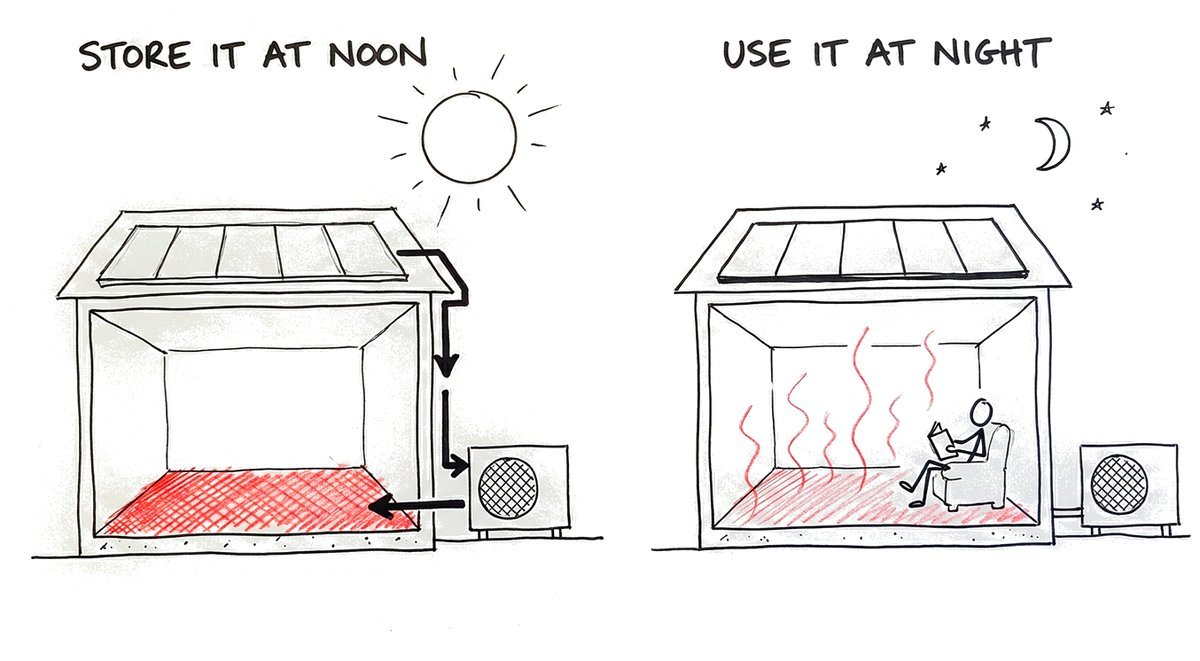
Many people plan to heat the slab while the sun is out and let it carry the house through the night. It works, up to a point. Phil’s experience is that a preheated floor helps for a few hours, and then the room starts to cool and the heating has to come back on, often by 8pm or earlier. Mornings are harder still, after a long night with no sun at all.
Where can I store the midday sun?
Solar helps most when there’s somewhere to put the warmth. The floor itself is the first store: a slab or screed with good insulation underneath holds heat into the evening, while a floor that leaks into the ground loses up to 70 percent of it, so there’s nothing left to store. A storage tank is the second. On a Dalkeith project Phil has filmed, large tanks are heated with spare solar during the day, and the house draws on them at night instead of the grid. He calls the tank a thermal battery, and the bigger the tank, the bigger the battery.
The third is an actual battery, which stores electricity for the heat pump to use later. Whatever the store, the control decides how well it works. A timer set for midday can’t see a cloud pass or the oven go on, and quietly starts buying grid power. A controller that reads your solar surplus as it happens only sends the heat pump what’s spare.
 3 min
3 min
Does a Midday Saver plan or a battery change the sums?
They can. Synergy’s Midday Saver plan makes power between 9am and 3pm much cheaper and the 3pm to 9pm evening peak dearer, with overnight in between. A floor or a tank that can be charged in the middle of the day suits that pattern, but the evening is exactly when you want the heat, so the plan only pays if the design moves enough of the heating into the cheap hours. We look at it properly in running floor heating on cheap midday power.
A home battery covers the evening from your own panels, and the WA Residential Battery Scheme offers Synergy customers a rebate of up to $1,300 if they join a virtual power plant. Whether a battery will carry a heat pump through a winter night depends on the size of both, which we go through in solar, a battery and winter heating.
Where does solar do the most work?
Outside the coldest weeks, and away from the floor. On a mild spring or autumn afternoon the heat pump can run on what the roof is making anyway. In summer, when solar is at its strongest, Phil uses the spare power to cool the house a degree further in the afternoon, to heat the tap water, or to warm the pool, rather than sell it back for very little. That’s the idea behind a whole-home system: one heat pump and one set of controls deciding where each spare unit of solar goes. Our whole-home page shows how it fits together.
What solar can’t do is make up for a system that leaks heat. We were once asked to look at a house with 10 kilowatts of solar on the roof, whose owner expected bills near zero. Summer bills ran at $500 to $600 a month just for hot water, and over $1,000 in winter, with heat escaping around the clock from uninsulated hot water pipes cast into the slabs and walls. Get the system right first, then let the panels do their part.
Other questions people ask us
Can I connect the panels straight to the floor heating?
No. The panels make electricity and the floor needs warm water, so a heat pump sits between them. Running electric cables in the floor straight off solar is possible, but you get a third of the heat you’d get through a heat pump.
How many panels do I need to run floor heating?
There’s no rule of thumb that holds. It depends on the heat pump, how much the house needs on a July morning, and what your roof actually makes in July rather than January. We work that out from your house before suggesting anything.
Will solar make my floor heating free to run?
No. Our modelled estimate for a well-built 200 m² floor on an air-source heat pump is about $240 a winter month at Synergy’s July 2026 rate. Solar can take a real share of that, most in spring and autumn and least on July mornings, but it won’t take it to zero.
What about solar hot water panels on the roof?
They make most of their heat in summer, when you need it least. They usually only make sense alongside a pool, which can soak up the summer surplus. More in are solar hot water panels worth adding.
Where to go from here
If you’re building or renovating in Perth or the south-west, the 5-minute quote gives you your options in writing within 3 working days, each with its price and a modelled running cost, and you don’t need plans to start. Tell us the size of your solar system in your notes and we’ll design around it. If you’re still weighing it up, the Running Cost Calculator shows what a well-built floor costs to run before any solar comes off.