
Can I keep a wood fire or gas fireplace with floor heating?
The short answer
Yes, and plenty of people do. Floor heating is the background warmth that keeps the whole house comfortable all day, and a wood fire or gas fireplace is the glow you light on a cold evening. They get along well if a few things are planned: the floor is designed to heat the house on its own, the thermostat for that area sits where it can’t feel the fire, and you expect the room to run a little warm on fire nights, because a heated floor eases off more slowly than a fire warms up. A fire on its own warms one room, or one end of it.
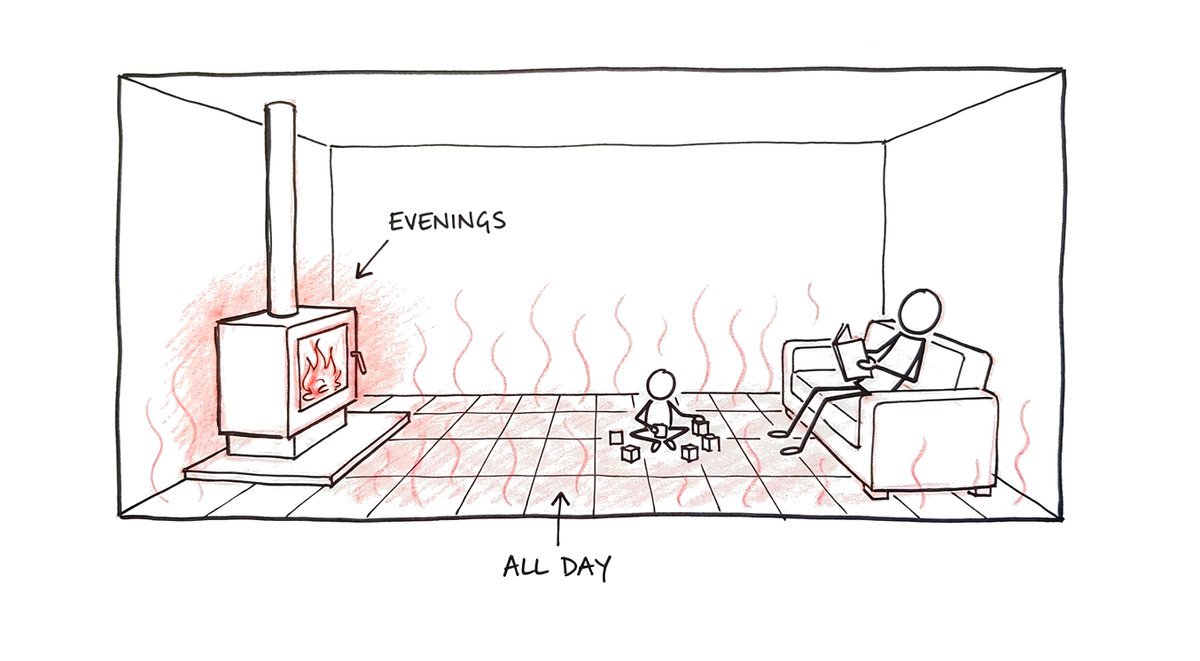
A fire is one of the real pleasures of winter, and nobody building a new home wants to be told to give it up. You don’t have to. What’s worth settling early is what each one is for, because that changes how the floor heating is designed and where its controls go.
Do I still need other heating if I have floor heating?
No. A floor heating system designed for your house covers the whole heating load on its own. The idea that floor heating only takes the edge off cold tiles comes from systems that were never designed properly and never quite got the house warm. Where one room loses more heat than its floor can put back, say a wall of glass or a double-height void, the heat-load calculation shows it before anything is built, and it’s dealt with at that stage.
So if you keep a fire, keep it because you love it. We design the floor to heat the house as if the fire weren’t there, because plenty of nights it won’t be lit. You’re out, you’re tired, or it’s 6 on a July morning and nobody wants to lay a fire before breakfast.
What does a fire do that the floor doesn’t?
A wood heater or gas fireplace is a very hot thing in one spot. It warms whoever sits in front of it beautifully, and the far end of an open-plan room and the rest of the house stay much cooler. Phil makes the same point about any heater in the corner of a room: it has to run at 90 or 100 degrees to push warmth across the room, so it’s hot near it and cool away from it. A heated floor works the other way, spreading gentle warmth over the whole floor from water at around 40 degrees, so every corner is comfortable and nothing is hot to touch.
That’s why the two live together so easily. The floor carries the house through the day and night, and the fire is the focal point on the evenings you choose. It also means the fire doesn’t make the floor heating work harder. When the fire warms the room, the floor heating gets asked for less, and uses less, that evening.
 6 min
6 min
How do I stop the room overheating when the fire’s lit?
A heated floor holds a lot of warmth and changes temperature slowly. A thin screed starts to respond in 15 to 30 minutes and a slab on the ground in about 45, and a good fire warms a room faster than either can ease off. So on fire nights the living area can run a touch warm for a while. Two things keep it in hand.
The first is where the thermostat goes. A good room sensor reads both the air and the warmth radiating onto it, because, as Phil says, “the temperature of the floor does not equal the temperature that you and I feel in the room.” Put it where it can see the fire and it will decide the whole zone is warm and turn the floor down, including the parts the fire never reaches. Put it on an inside wall, away from the fire and out of any cupboard, in the part of the house that zone serves, and it keeps doing its job.
The second is the timer. If you light the fire most evenings, set the living area a degree or two lower from late afternoon and let the fire bring it up. In a two-storey home, or a big single-storey one split into two zones, the living areas usually have a zone of their own anyway, so this changes nothing for the bedrooms. Our article on setting a different temperature in each room explains how zones are usually set up.
Wood heater or gas fireplace: does it make a difference?
For the floor heating, not much. Both are a hot spot in one room, and both need a flue and air to burn. Tell us where the fire will go when the floor is being designed, because it changes the numbers for that room, where the thermostat goes and how the pipes are laid out around the hearth. A wood fire needs its air supply thought about in a well-sealed modern home, especially one with heat recovery ventilation, and our article on heat recovery ventilation and a wood fire covers that.
If the house is getting gas for a fireplace anyway, you might wonder about running the floor heating on gas too. We install both gas boilers and heat pumps. On running cost a heat pump usually comes out ahead in Perth, so it’s what we suggest first, and if you’d rather have gas we’ll design and install a gas boiler. Our article on gas boiler or heat pump sets out the choice.
Other questions people ask us about fires and floor heating
Can my wood stove heat the water for the floor heating?
Some wood stoves have a water jacket that can add heat to a hydronic system. It only works while the fire is burning, so it can top the system up but can’t replace the heat pump, and it needs a tank and safety controls designed in from the start. If it’s something you want, say so when you ask for your quote.
Will the floor heating fight the fire?
Not if the thermostat is in the right place. The floor heating follows the room temperature, so when the fire has the room warm, it simply asks for less heat. The only thing it can’t do is cool the room down quickly, which is why the timer trick above helps on fire nights.
Is a fire still worth having with floor heating?
If you love sitting in front of one, yes. You won’t need it to stay warm, and that’s the point: it becomes something you light for the pleasure of it on a cold evening, and nothing in the house depends on it.
Where to go from here
If you’re building in Perth or the south-west, the 5-minute quote gives you your options in writing within 3 working days, each with its price and a modelled running cost, and you don’t need final plans to start. Mention the fire in your notes so it’s allowed for. If you’d like to see the running cost for your floor area first, the Running Cost Calculator shows the built-right and built-cheap numbers in two minutes.