
How warm will floor heating keep my house on the coldest Perth mornings?
The short answer
As warm as you set it, if the floor is designed for your house. A properly designed heated floor holds every room at its set temperature on Perth’s coldest mornings, not just its average ones, and we suggest starting around 20 degrees in the living areas, which many people find is warmer than it sounds. On 25 July 2025, Mt Lawley dropped to 0.3 degrees, the coldest Perth morning in 15 years, and that’s the kind of morning the design has to cover. Whether a house gets there depends on the sizing behind the floor, which shows up either in the heat-load calculation or on that first cold morning.
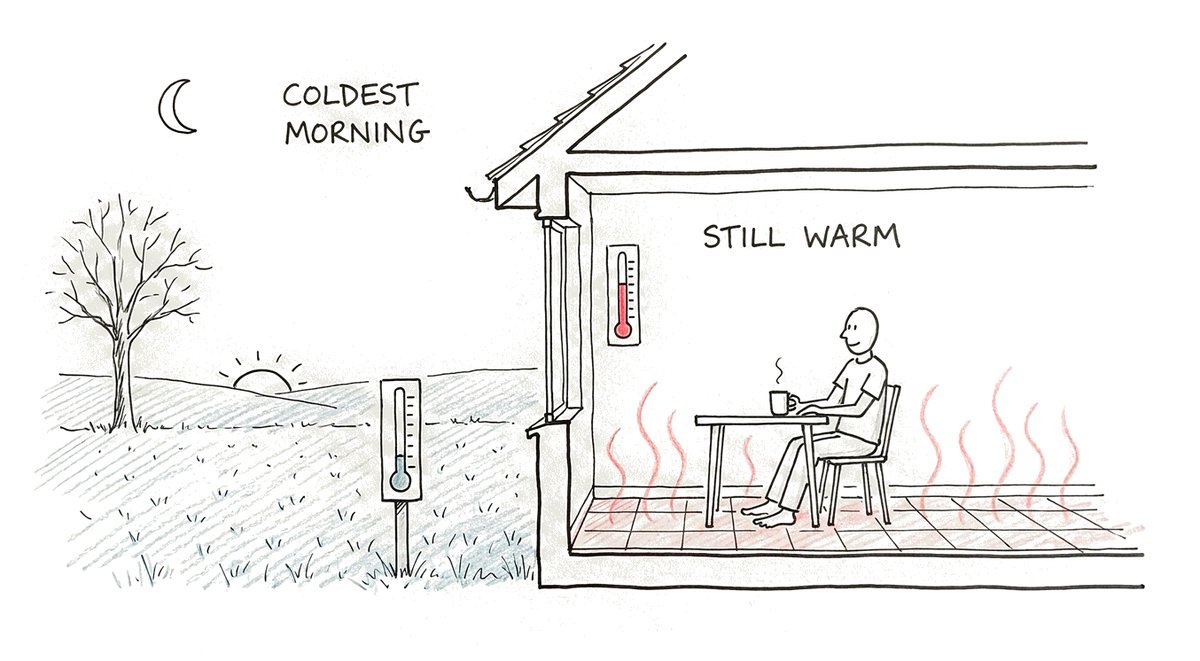
It’s the question behind most of the others. Anyone who’s lived with a split system knows the feeling: the thermostat says 21, the back bedroom says otherwise, and on the coldest mornings the house never quite gets there. Before spending money on floor heating, people want to know it won’t do the same.
How cold do Perth mornings actually get?
Colder than our reputation. The Bureau of Meteorology’s Perth station averages 8.1 degrees overnight in July and 18.5 in the afternoon, so most winter mornings start cool and most afternoons end mild. Then there are the snaps. On 25 July 2025, Mt Lawley dropped to 0.3 degrees at 6:55am, its coldest morning since 2010, and Jandakot got down to minus 1.3.
Those are the mornings that test heating, because they come before sunrise, after a long night in which the house has been losing heat the whole time. A system that copes at 8 degrees and falls short at 1 is the one people complain about, and they only find out in the coldest week of the year.
What does “designed for the coldest mornings” mean?
It means the heating is sized for a cold morning near the bottom of what your area gets, not an average one. The heat-load calculation works out how much heat each room loses on that morning, and the pipe spacing, the floor build-up and the heat pump are chosen to put it back. On every warmer day, which is nearly all of them, the system has capacity to spare, and the controls simply send cooler water. Our handover notes give the idea: water around 25 degrees when it’s 20 outside, rising to around 37 when it’s 10.
The heat pump needs that margin more than anything else in the house. It collects heat from the outside air, and Phil’s way of putting it is that it’s much easier to pull heat out of 20 degree air than out of 7 degree air, so a frosty morning is exactly when it works hardest. Sized for an average night, it runs flat out and still loses ground.
For the systems we design and build, this is what The Comfort Guarantee covers in plain words: every room reaches and holds the temperature we designed it for, through Perth’s coldest mornings, and if it doesn’t, we fix it at our cost. It only applies where we did the design, because the promise rests on the design.
What temperature should I set, and what will it feel like?
Lower than you’d set an air conditioner, in most cases. Most of a heated floor’s warmth reaches you by radiation, the way sunshine warms your face on a cold day, and the walls and furniture warm up too, so the room feels warmer than the same air temperature from a split system. Our handover advice is to start the living areas around 19 or 20 degrees and go up half a degree at a time, a few days apart, until it feels right. People are often surprised how low they end up, and most like the bedrooms a little cooler again.
Underfoot, tiles and polished concrete feel gently warm on a cold morning, never hot. That gentle surface is also the floor’s limit: each square metre can only give so much heat before it would feel too warm to stand on. A room that needs more than that, usually because of a wall of glass, shows up in the heat-load calculation and gets dealt with at the design stage. Setting the thermostat itself is covered in what temperature to set floor heating at.
Should I turn it down at night or when we’re out?
Down a little, on a timer, rather than off. A typical set-up holds the comfortable temperature through the morning and evening, say 5.30 to 8.30am and 4.30 to 10pm, and lets the house drift a few degrees lower in between, to something like 17. Switching it right off overnight sounds like a saving, but then the floor has to pull the whole house back up from cold before breakfast, at the coldest hour, and the system has to work harder to catch up. Our handover notes put it this way: the lower setting is a sleep mode, not a money-saving mode.
How early the morning warm-up starts depends on the floor. A thin insulated screed starts giving out warmth within about 15 to 30 minutes, a heated slab on the ground within about 45 minutes to an hour, and a well set-up controller knows which one it’s driving. More on that in how long floor heating takes to warm up.
What stops a house reaching its temperature?
Almost always something decided before the slab was poured. The usual culprits are a room with more glass than its floor can make up for, a slab with no insulation under it that loses up to 70% of its heat into the ground in the worst cases, and a heat pump boxed into a side path, breathing its own cold air and losing up to half its efficiency. A thermostat tucked away in a cupboard can do it too, because it’s reading the wrong room.
None of these shows on a mild May evening, and all of them show on a morning like 25 July. We go through them in floor heating mistakes you can’t fix once the slab is poured.
Other questions people ask us
Will I need another heater on the coldest days?
Usually not. In a home built to today’s standards, a properly designed floor covers the whole heating load. Where a room loses more heat than its floor can put back, the heat-load calculation shows it before construction, and it’s dealt with then.
Is the design different outside Perth?
The design uses the conditions where you’re building. A frost-prone site inland gets more allowance than a house near the coast, which is one reason a rule of thumb copied from someone else’s house doesn’t travel well.
Can I turn it up on a really cold morning?
You can, but a heated floor responds slowly, so turning it up at 6am won’t do much by breakfast. If the house falls short on cold mornings, start the timer earlier, and if that doesn’t fix it, something in the design is short and worth finding out.
Where to go from here
If you’re building in Perth or the south-west, the 5-minute quote gives you your options in writing within 3 working days, each with its price and a modelled running cost, and you don’t need plans to start. If you’d like to see what that warmth costs to run first, the Running Cost Calculator shows modelled estimates for your floor area, built right and built cheaply.