
What rules apply to installing radiators in WA?
The short answer
In Western Australia, the parts of a radiator job that touch your gas, your electricity or your drinking water must be done by licensed people. A gas boiler needs a licensed gas fitter, who gives you a Notice of Completion within 48 hours; the heat pump’s power needs a licensed electrical contractor, who gives you an electrical safety certificate within 28 days; and any work on the water supply needs a licensed plumber. An outdoor heat pump also has to meet WA’s noise rules. None of these rules checks whether your rooms will be warm, which is down to the design.
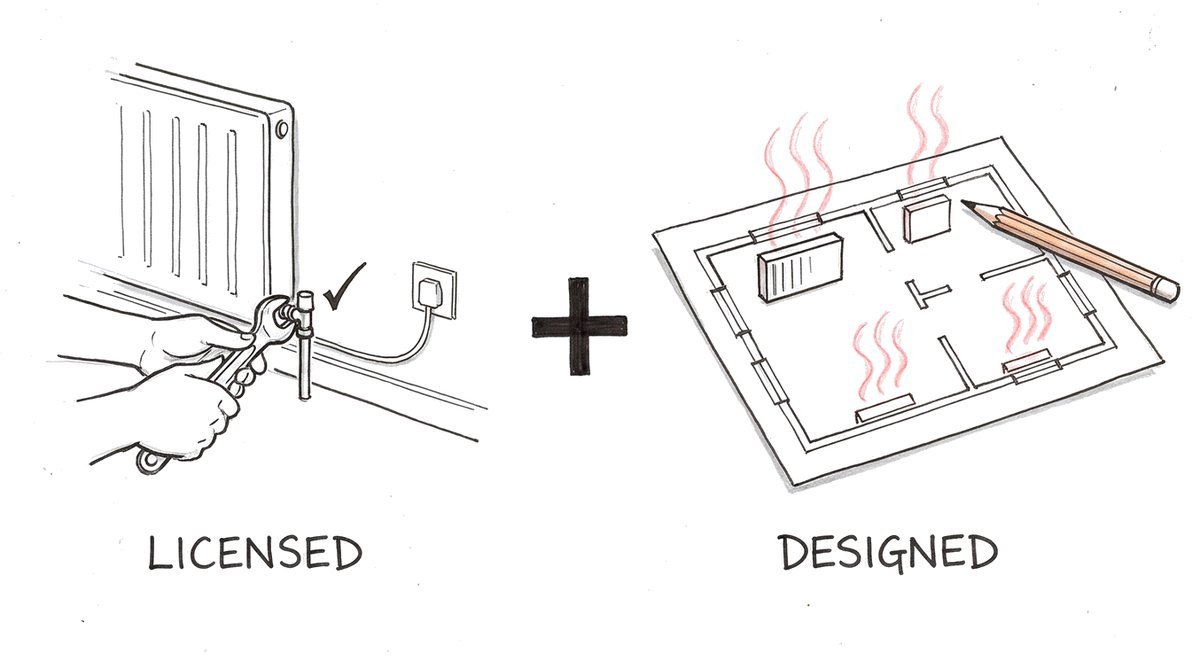
It’s a sensible thing to check before anyone drills a hole. A radiator system touches three things that are tightly regulated in WA, the gas, the electricity and the water supply, and a fourth, the design, that the rules mostly leave alone. Here’s what applies, who signs off what, and what to ask for.
Gas: a licensed gas fitter and a Notice of Completion
If your radiators will run on a gas boiler, connecting it is gasfitting, and in WA the law requires all gasfitting to be done by someone licensed by Building and Energy. When the work is finished, the gas fitter must give you and the gas supplier a Notice of Completion within 48 hours. Keep it with the house papers. It’s the record that the work was done by a licensed fitter and meets the standards.
Electricity: a licensed contractor and a safety certificate
A heat pump needs power, usually its own circuit from the switchboard, and in some older houses the switchboard needs an upgrade to take it. In WA all electrical work must be done by someone with the right electrical licence, through a licensed electrical contractor. For anything beyond maintenance or a like-for-like replacement, the contractor must give you an electrical safety certificate within 28 days. If one doesn’t arrive, ask for it.
Water: what counts as plumbing
WA’s plumbing licence covers water supply, sanitary and drainage work: the pipes that bring drinking water from the meter to your taps, and the pipes that take waste away. That work must be done by a licensed plumber, apart from a short list of small jobs a homeowner may do, such as replacing a shower head. For major work, like new fixtures or a replacement water heater, the plumbing contractor must give you a certificate of compliance within five working days.
The water inside a radiator system is a different thing. It runs in a sealed loop, filled once and treated so the steel inside doesn’t corrode, and it never mixes with the water from your taps. Where the job does touch your drinking-water supply, such as the connection used to fill the loop or any change to your hot water system, that part is plumbing work for a licensed plumber.
Heat pumps: noise, and sometimes refrigerant
An outdoor heat pump has a fan and a compressor, so like an air conditioner it has to meet the Environmental Protection (Noise) Regulations 1997. The City of Nedlands’ guide for installers puts the limit from 10pm at 35 dB(A) in most suburban areas, and under the Environmental Protection Act, installing equipment that makes unreasonable noise is itself an offence. In practice that means a quiet unit, placed away from the neighbours’ bedrooms, which is good design anyway. Our article on how loud a heat pump is covers choosing and placing one.
Some heat pumps come in two parts joined on site by refrigerant pipes. Handling refrigerant to do that needs a refrigerant handling licence under federal law, issued by the Australian Refrigeration Council. Many hydronic heat pumps come as one sealed outdoor unit, filled at the factory, and then nobody handles refrigerant on site at all.
What the rules don’t cover
Every rule above is about safety: no gas leaks, no electric shocks, nothing getting into the drinking water, nothing keeping the street awake. None of them asks whether the panel in your back bedroom is big enough, whether the pipes in the roof were insulated, or what temperature the water was designed to run at. Those decide whether you’re warm in July and what the system costs to run.
That’s no criticism of the trades. Connecting a radiator safely is their job, and they do it well, but a standard installation covers the physical steps, not the engineering that makes those steps count. Phil, whose team gets calls almost every week about radiator systems that don’t heat as promised, puts the gap this way: “They know how to hang a radiator on the wall, connect some pipes to it, but they don’t know how to get every ounce of efficiency and comfort out of the system.”
So alongside the certificates, ask for the design. You want a heat-loss figure for each room, the panel chosen to match it, and the water temperature the system is designed to run at. On a heat pump that should be around 45 to 55 degrees, and seventy means nobody designed it for a heat pump. Our article on heat-load calculations explains what a room-by-room figure looks like.
Other questions people ask us
Do radiators need council approval?
Radiators inside the house rarely involve the council. The outdoor heat pump is the part to think about: if your house is heritage-listed, or in a strata complex, check with the council or the strata company before it goes somewhere the street can see or on common property.
Can I install radiators myself?
You can hang a panel on a wall, but the gas, electrical and drinking-water connections must be done by licensed trades. And the sizing, the part no licence checks, is what decides whether the system ever warms the house.
Who signs off a system you install?
We’re fully licensed and insured. Licensed tradespeople do the gas, electrical and plumbing connections as part of the job and you get the certificates the law requires. We design, install and commission the heating itself, and The Comfort Guarantee covers how it performs.
Where to go from here
If you’re in Perth or the south-west, the 5-minute quote shows your options in writing within 3 working days, each with its price and a modelled running cost, and you don’t need plans to start. If you’re still working out whether radiators suit your house, our article on adding radiator central heating to an older home covers what the job involves, and the free radiator guide explains how each room is sized.