
Can my home’s heat pump or geothermal system heat the pool and spa too?
The short answer
Yes. The heat pump that warms your floors in winter sits idle through summer, when you want the pool warm, so it can heat the pool through a heat exchanger without the pool water touching the heating water. An ordinary air-source heat pump does this well, because warm summer air is an easy place to find heat. A geothermal system can heat a pool too, and on a project with air conditioning, floor heating and a pool together, heat-recovery geothermal can pay back in as little as about four years. For a pool on its own, the ground is a weaker summer heat source than warm air.
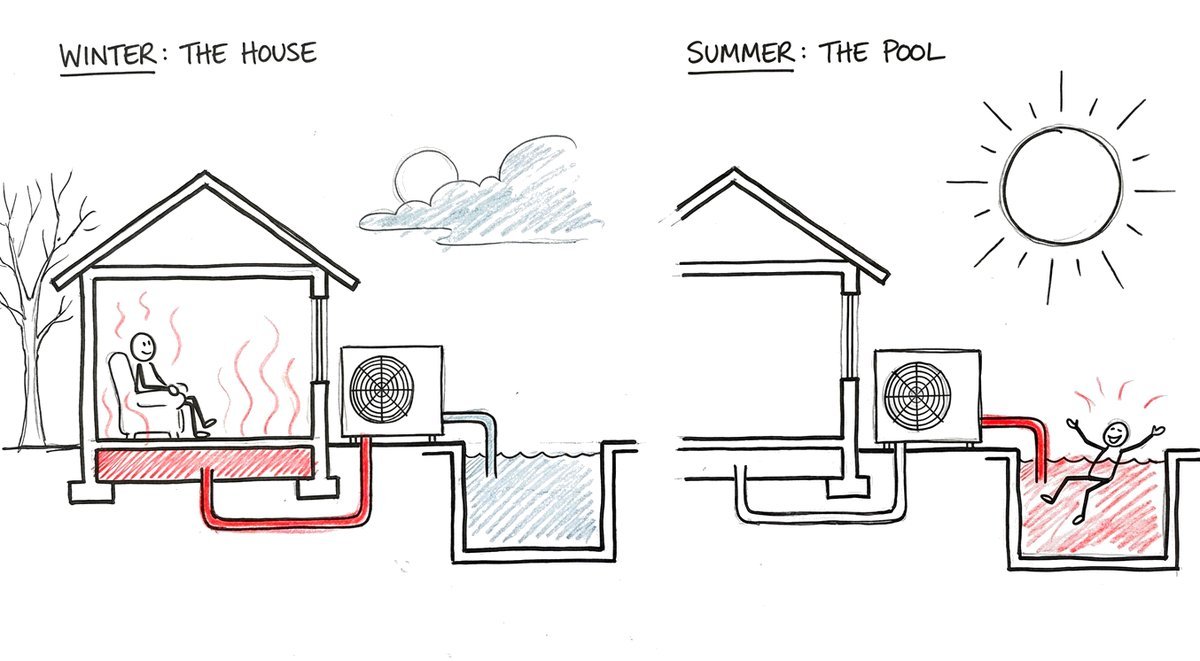
This question usually comes up when people plan floor heating and a pool in the same build, and notice they’re about to buy two heaters for two different seasons. Phil gets asked it often enough to have made a video about it. The answer is good news, with one catch for anyone who has their heart set on geothermal.
How can one heat pump heat the house and the pool?
A floor heating system works hard from May to September and does nothing from October to April. A pool is the other way round: nobody wants to swim in July, and everybody wants to in February. So the heat pump that heats the house in winter can be switched over to the pool for the warm half of the year, and the two jobs hardly ever compete.
The pool water and the heating water never mix. Between them sits a heat exchanger, where the warm heating water flows on one side of a thin metal wall and the pool water on the other, so the heat crosses over and the chlorine stays in the pool. It’s an old, well-proven piece of equipment, and it means the pool’s chemistry never reaches your floor pipes.
The part that needs engineering is the size. A heat pump chosen only for the house may be too small to also bring a pool up to temperature, so both loads have to be worked out together at the design stage. Where the heat pump is sized for both, you don’t need a separate pool heater at all, which is a large part of why we design heating, cooling, hot water and pool as one system.
Is a geothermal system better for heating a pool?
Not in summer, which surprises people. A geothermal heat pump draws its heat from the ground, which a few metres down sits at around 15 degrees all year. On a cold July morning that’s a big advantage, because the outside air might be 5 degrees. But in summer, when you actually want the pool warm, the air is 25 to 35 degrees, and pulling heat out of that warm air is easier than pulling it out of 15 degree ground. Phil’s view is that for summer pool heating, a ground loop is less efficient than a plain air-to-water heat pump.
There are ways round it. A hybrid system can take heat from the air when the air is warmer and from the ground when it isn’t. And Perth’s groundwater, at around 21 degrees, is a better source than the ground itself where you can reach it. But if a pool is the main reason you’re looking at geothermal, the arithmetic usually points to air.
When does geothermal with a pool pay for itself?
When the house is also being air-conditioned. Cooling a house means taking heat out of it, and an ordinary system throws that heat away outside. A heat-recovery geothermal system catches it and sends it into the pool, so the pool is warmed by heat the house wanted rid of. That’s why Phil recommends geothermal in houses that have a pool, floor heating and cooling, and air conditioning, as a minimum. On the right project, the payback can be as short as about four years, the best economics geothermal ever produces.
Phil filmed one of these in Dalkeith, on Perth’s groundwater. When the house is being cooled, the heat goes first into the tap hot water tank, then into the pool, and only when both are full does the system dump heat into the ground. Through summer the pool sometimes sits at 32 or 33 degrees. Asked whether everyone should build one, Phil was straight: “Should everybody do this system? And the short answer is no.” Without the pool, he says, the numbers on that same system wouldn’t stack up.
So the pool is often what makes geothermal worth it, and rarely a reason on its own. Our article on what geothermal costs and when it pays off goes through the arithmetic.
Will it cost nothing to run?
No, and be wary of anyone who says it will. A heat pump heating a pool in summer is working in warm air, so each unit of electricity brings in several units of heat, and it costs much less than heating the same water with an electric element. Time it to run while your solar panels are producing and most of that electricity is power you’d otherwise export to the grid for 2 cents a unit, under the WA Government’s buyback rates for midday exports. Cheap, yes. Free, never.
The other half of the running cost is the pool itself. A pool loses heat every night, and a heat pump that warms an uncovered pool is refilling a leaking bucket. A cover on the water when nobody’s swimming does more for the bill than any choice of heat source, as we explain in keeping the heat in your pool.
What about the spa?
A spa can be heated the same way, through its own heat exchanger off the same system. The difference is temperature. A heat pump finds it much easier to make 30 to 35 degree water than 50 to 55 degree water, and a spa runs a lot hotter than a pool, so the spa is a small, hot job and the pool a big, warm one. Both are worked out in the design, along with how quickly you want the spa ready when you switch it on.
Other questions people ask us
Will heating the pool take heat away from the house?
Not when it’s designed properly. The house gets the heat pump in the cold months and the pool in the warm ones, and we don’t recommend heating a pool through a Perth winter anyway. On the in-between days the controls decide which comes first.
Can I add the pool to my existing heat pump later?
Sometimes. A heat exchanger and a pool circuit can be added to an existing system, but whether the heat pump can carry the pool depends on how big it is and how big the pool is. That’s a calculation, not a guess, so ask for it before anything’s bought.
Could a gas boiler heat the pool instead?
It can, and we install gas boilers as well as heat pumps. For a pool, though, Phil’s view is that gas is the most expensive way to go, because a pool loses heat all the time and a gas heater keeps burning gas to replace it. A heat pump in warm summer air is the cheaper machine to run.
Can the air conditioning’s waste heat warm the pool without geothermal?
Yes, with the right kind of heat pump, one that cools the house and heats water at the same time. We explain how in using your air conditioner’s waste heat for the pool.
Where to go from here
If you’re building or renovating in Perth or the south-west, the 5-minute quote gives you your options in writing within 3 working days, each with its price and a modelled running cost, and you don’t need plans to start. Mention the pool and the spa in your notes so both are sized in. If you’d rather read first, our pool heating page shows how a heat pump warms a pool on solar you’d otherwise export, and geothermal, straight says when the ground earns its keep.