
Can I have floor heating and air conditioning in the same house?
The short answer
Yes, and in Perth it’s a natural pairing: the floor for winter, air conditioning for summer. They can be two separate systems, which is usually cheaper to put in for a typical home, or one heat pump can run the floor heating and a ducted air conditioning system together, which earns its keep in larger homes or where there’s no room for several outdoor units. The floor can cool a little as well, but in Perth floor cooling covers only about a quarter of the cooling a typical house needs, so it works alongside air conditioning and never replaces it.
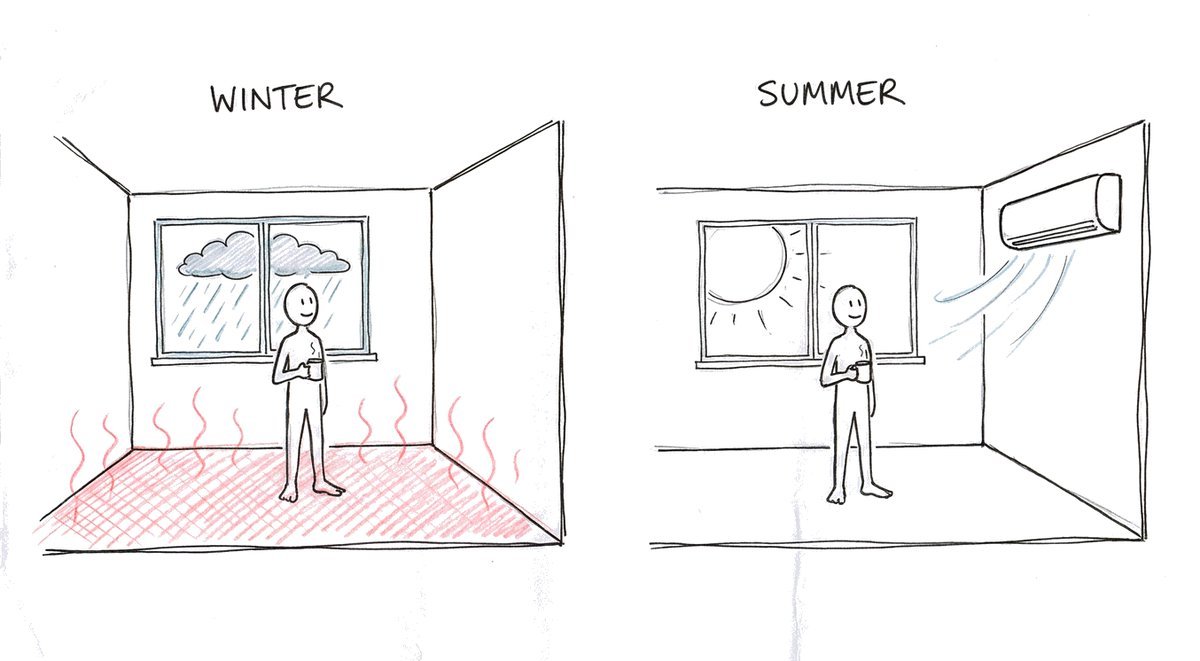
Perth asks a lot of one house: cold, damp mornings in July and summer afternoons in the high 30s. If you’re building here, air conditioning is probably already on your list, so the question we hear is whether floor heating can sit alongside it, or whether it means paying twice for the same thing.
Can’t the air conditioning do the heating too?
It can. A reverse-cycle air conditioner is a good, cheap way to heat a room, and if it keeps you comfortable you may not need anything else. People add floor heating for what blown air can’t give them: warmth that starts at the floor where you are, a quiet house with no air blowing on your neck, and warm tiles on a July morning. Built right, a heated floor in a 200 m² Perth home runs at about $240 a winter month (a modelled estimate at Synergy’s July 2026 rate), in the same league as a good reverse-cycle system, so you’re choosing it for the comfort.
Summer is the other way round. Air conditioning is very good at cooling, and a floor can only do a small part of that job. So a house with both uses each for what it does best, and our comparison of floor heating and ducted reverse-cycle goes through the trade-offs in detail.
Separate systems, or one heat pump for both?
Both work. A heat pump can make chilled water as well as warm water, so the machine that heats the floor in winter can also feed a ducted air conditioning system in summer: a fan coil in the roof, ducts and grilles, exactly like ordinary ducted air conditioning, but run from one central heat pump instead of an outdoor unit of its own. Phil has filmed a Cottesloe house that works this way, with one heat pump running the floor heating, the floor cooling and the ducted air conditioning, and grilles made to the architect’s drawings.
For a typical home, two separate systems are usually still cheaper to put in. Combining earns its place in larger homes, or where there’s no room for several outdoor units: one plant instead of three or four, and a smaller power supply, perhaps 32 amps for one central unit where separate machines can need 80 or more between them. It can also send the heat the air conditioning pulls out of the house into the pool or the hot water instead of the sky.
The catch is that combining takes more design and more work on site, so it costs more to put in. Our page on whole-home systems shows how it’s planned.
 2 min
Can the floor cool the house as well?
A little, and it’s pleasant when the system is designed for it. Cool water through the floor pipes takes the edge off a warm day quietly and cheaply, with no cold air blowing on anyone. There’s a hard limit, though. In Phil’s words, “floor cooling can only provide, in Perth, about a quarter of the cooling output that’s typically required for the standard house design and level of thermal insulation that we’re used to.” On a 30 degree day it might take about one and a half degrees off inside.
Cool air sinks and stays near the floor, and a floor can’t take moisture out of humid air the way air conditioning does. So floor cooling is a helper. It does part of the job on warm days, and the air conditioning comes in for the hot, sticky ones. It also has to be controlled with care, because a floor run too cold on a humid day can gather condensation, the way a cold drink gets wet on the outside on a summer afternoon. Our article on whether floor cooling can replace air conditioning explains where it helps and where it doesn’t.
Can they run on the same day without fighting?
They can, and in Perth’s autumn and spring they often do: a cold morning, then a warm afternoon. What you don’t want is the two working against each other, with the floor still giving out the morning’s warmth while the air conditioning tries to cool the same room. That happens with heavy floors that react slowly, such as a heated suspended slab still pumping out heat into a 26 degree afternoon, and with two systems on separate controls that know nothing about each other.
The answers are decided at design. A floor that responds quickly helps most: an insulated screed starts warming in 15 to 30 minutes and cools down quickly too. The heating is timed for the cold part of the day. And where it’s one system, one set of controls decides which part runs. In the Cottesloe house the controls know when the floor is doing enough, and bring the air conditioning in only when it’s getting too warm inside or the humidity is up.
Other questions people ask us
Do ceiling fans help?
In summer, yes. Moving air makes you feel cooler, so a fan lets you set the air conditioning a little warmer, and it works well with floor cooling. In winter, with floor heating, you won’t need them. People run fans slowly in winter to push warm air from a split system back down from the ceiling, but a heated floor doesn’t pile warmth up under the ceiling in the first place.
I already have ducted air conditioning. Can I add floor heating?
In a new build or a big renovation where the floors are coming up, yes, alongside it. In a finished house, floor heating means lifting the floors, so radiators are usually the way to add hydronic warmth, as we explain in putting floor heating into an existing home.
Will I need two outdoor units?
With separate systems, yes: one for the air conditioning and one heat pump for the floor. With a combined system, one heat pump does both. Either way each unit needs room to breathe, and our article on where the heat pump should go explains why.
Does floor heating dry the air out like air conditioning?
A heated floor moves very little air, so there’s no warm draught across your face, and many people who get dry eyes from blown air notice the difference. We’re engineers, not doctors, so we’ll leave it at that.
Where to go from here
If you’re building in Perth or the south-west, the 5-minute quote gives you your options in writing within 3 working days, each with its price and a modelled running cost, and you don’t need final plans to start. Mention the air conditioning in your notes so we can show you separate and combined options side by side. If you’d like the running cost first, the Running Cost Calculator works it out for your floor area.